2026 will bring a host of new challenges to how we do email. The good news, we’re to help you get ready. Check out these email marketing trends for 2026 to make sure your email program is all set for the new year.
If 2024 and 2025 taught email marketers and senders anything, it’s that change is the only constant. Inbox providers rolled out new authentication rules, AI exploded into the email workflow, and customer expectations moved faster than many brands could adapt. And now, as we look toward 2026, email is entering a new era – one powered by intelligent inboxes, predictive AI, and a renewed focus on trust.
At Mailjet, we’re constantly analyzing the landscape across email senders, industry data, and broader communication trends. Below, we break down 7 data-backed predictions email marketers and senders should watch for in 2026, and what you can do today to stay ahead.
Despite louder competitors – yes, chat apps and AI assistants, we’re looking at you – email remains one of the most powerful and popular communication channels on the planet. In fact, Statista projects global email users to reach 4.7–4.8 billion by the end of 2026, with the number of emails sent daily expected to hit around 392 billion.
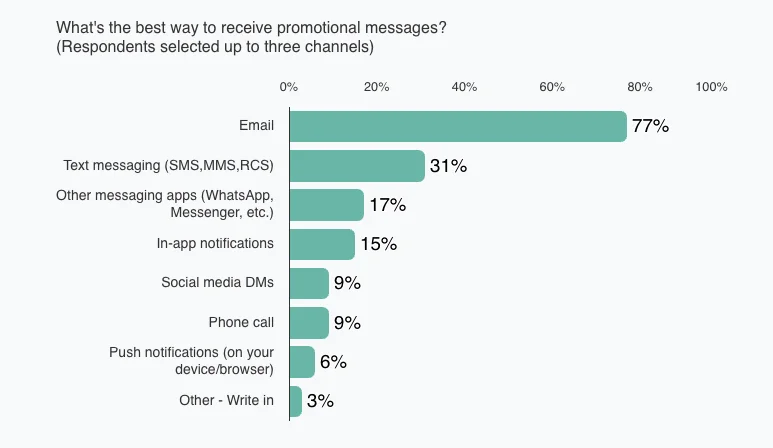
This sentiment was echoed in Sinch’s The state of customer communications report – published earlier this year – where a global survey of consumers selected up to three channels on which they’d like to receive promotions from brands.
As you can see, the tried-and-tested channel came out on top at nearly 77%.
So, while inboxes may evolve, change, and adapt to consumer needs – they’re not going away anytime soon. And those marketers and senders who evolve with them will win.
7 predictions for email marketing in 2026
#1 “Intelligent inboxes” will reshape how email is delivered and discovered
As email marketers and senders, we’ve moved past the era of one-size-fits-all campaigns. For years, we’ve relied on the standard playbook: using a subscriber’s first name or creating a few broad segments to make our emails feel more personal.
While this was a step in the right direction, today’s crowded inboxes and high customer expectations demand more. Simply put, basic email personalization is no longer enough to cut through the noise.
A major shift is already underway. By 2026, inbox providers like Google and Apple will play an even greater role as intelligent gatekeepers for your audience. Their systems will increasingly decide which messages get priority, which get summarized, and which get relegated to a secondary tab. The battle for the primary inbox is heating up, and the rules are changing.
So, how do you ensure your messages make the cut?
To earn and keep your place in the inbox, you must deliver demonstrable value. This means moving beyond generic promotions and using data to create truly relevant experiences that anticipate your customers’ needs.
For marketers, this means one thing: relevance becomes the new deliverability. If your message isn’t behaviorally targeted, timely, or genuinely useful, it will increasingly get filtered into secondary tabs – or quietly ignored.
Action for 2026:
Shift your strategy from “send to many” to “send to the right person at the right moment.” Engagement depth (clicks, conversions, replies) will matter more than raw volume.
#2 AI-driven personalization becomes standard, not “innovative”
Mailjet’s 2025 report highlighted the rising dependency on AI to speed up campaign production, improve segmentation, and personalize content. In 2026, expect that to go mainstream.
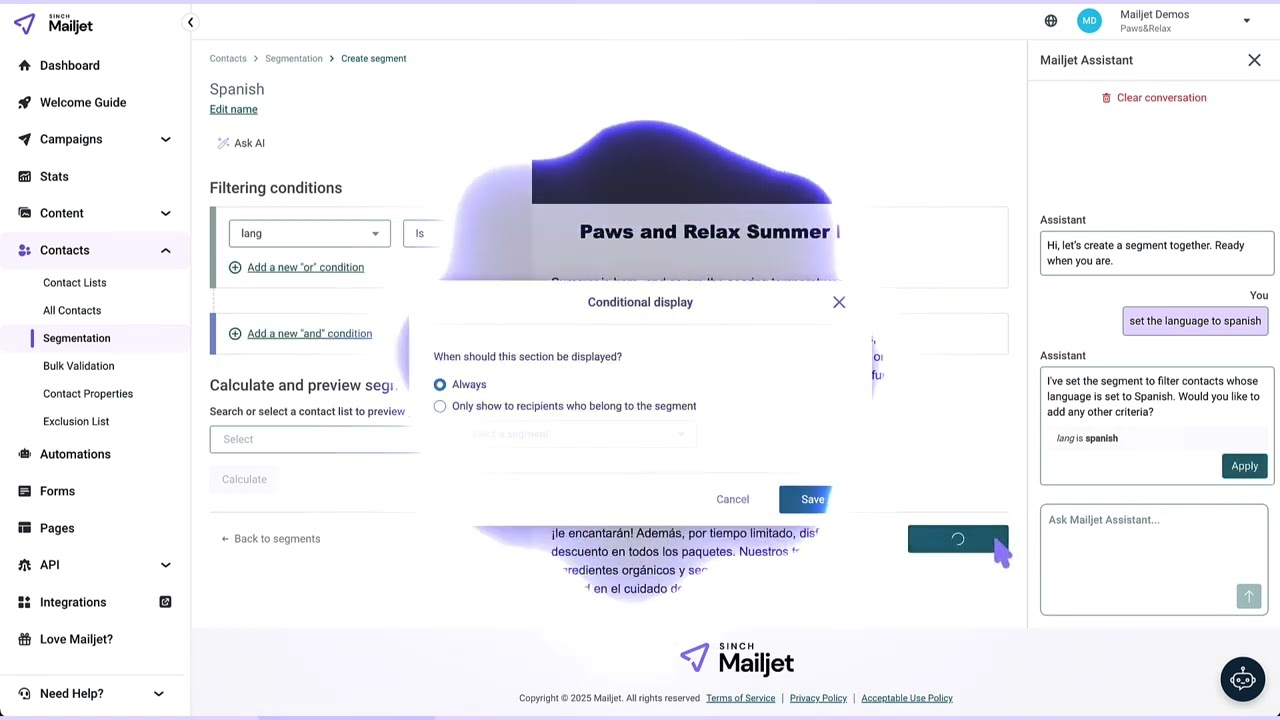
For example, Mailjet recently rolled out its new open-source MCP Server – a bridge that lets conversational-AI tools connect directly and securely to Mailjet’s API. This means marketers and senders no longer need to manually export dashboards or write SQL/data-analysis scripts to get insights. Instead, you can literally ask in plain language questions such as: “Show me the open and click-through rates of our last campaign by country,” or “Which segment had the highest unsubscribe rate last month?” for immediate, actionable answers.
Here are just a few ways you can leverage AI in email marketing to deliver the relevant campaigns your audience will come to expect from your brand:
Use case
Description
Example query
Hyper-specific performance analysis
Go beyond simple open and click rates. Ask the AI to pull detailed reports on campaign performance.
“Show me the top 5 countries by open rate for my last campaign. Also, what was the bounce rate for Gmail addresses?”
Automated content and template management
Let the AI help plan your content. Ask it which existing template performs best to help inform your next design.
“Pull up all my newsletter templates in the ‘Monthly Digest’ category. I want to reuse the one from last month.”
Workflow monitoring and optimization
Keep a close eye on your automated email sequences. Query the performance of a specific workflow to identify drop-off points.
“What’s the open rate for the third email in my ‘New User Onboarding’ workflow? Show me the stats for the last 7 days.”
This isn’t about more emails – it’s about smarter emails that feel tailor-made for every recipient.
Action for 2026:
Audit your tech stack. If your tools can’t handle behavioral segmentation, dynamic content, or AI optimization, you’ll be at a disadvantage.
#3 Authentication and trust signals become non-negotiable
Stricter inbox rules from Google, Yahoo, and other major providers have pushed email authentication from best practice to bare minimum, especially for bulk email senders in 2025–2026. SPF, DKIM, and DMARC now form the essential identity layer that proves a sender is legitimate and that messages haven’t been altered.
Yet adoption is still uneven. Mailjet’s Road to Inbox 2025 report shows that while 66.2% of senders use both SPF and DKIM, more than 25% aren’t sure whether they’re authenticated at all, and only about 53.8% have a DMARC policy, many of which remain at the non-enforcing “p=none” level. As inbox providers continue tightening requirements, that gap becomes a real risk.
So, for 2026, authentication won’t just determine whether you make it to the inbox – it will increasingly shape how inbox providers rank, filter, or flag your messages. Stronger DMARC enforcement (quarantine/reject), aligned authentication across all sending domains, and consistent domain reputation will be baseline expectations.
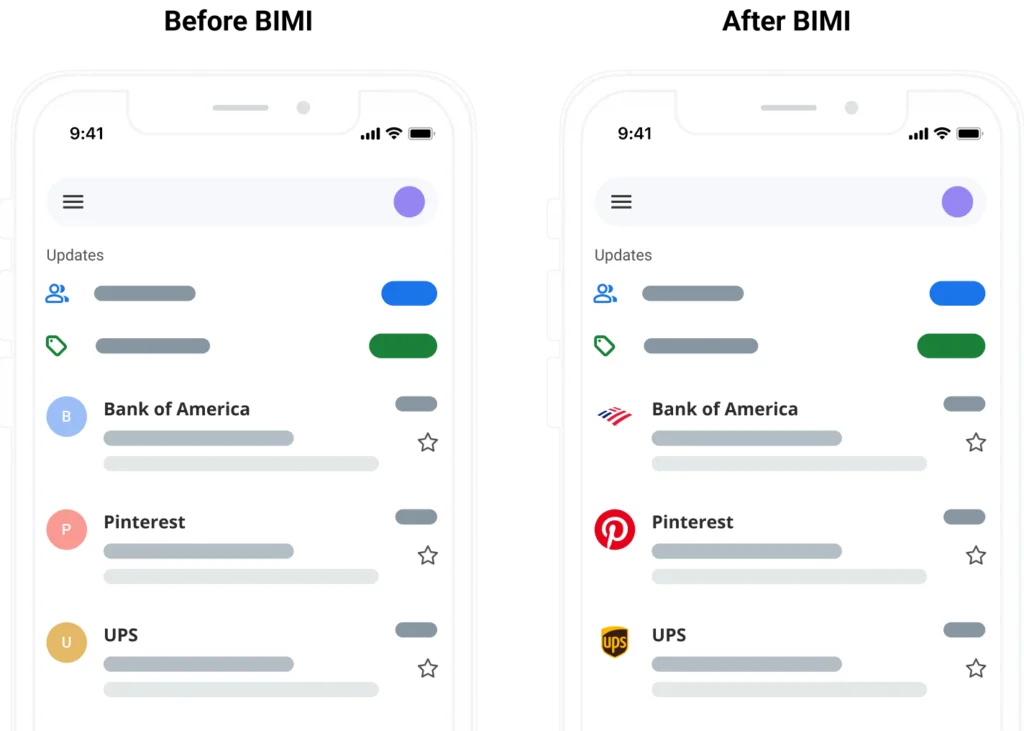
It also becomes the gateway to added trust signals like BIMI, which allows brands to display their official logo in inboxes, but only after DMARC is properly enforced. In a world of phishing, spoofing, and rising user skepticism, authenticated identity becomes a core element of brand trust, not just a technical spec.
Authentication also directly supports the other email trends emerging for 2026, especially AI-driven personalization and dynamic content. These advanced, data-informed email experiences only work if the message reliably reaches the inbox – and inbox placement now depends as much on technical trust as on engagement.
With smarter inboxes evaluating sender reputation, identity, domain alignment, and user behavior together, authentication becomes part of a broader deliverability profile. For senders adopting lifecycle automation, predictive content, or micro-segmentation, authentication ensures these efforts aren’t undermined before the email is even seen.
Action for 2026:
Get ahead of evolving requirements now. Review domain authentication, enable alignment, and maintain meticulous email list hygiene.
#4 Email becomes part of a unified omnichannel conversation
In 2026, email will increasingly be just one part of a larger, omnichannel marketing strategy. Not operating in a silo, but as a central node in a web of channels including SMS, chat/messaging, in-app notifications, and more. By treating email as the backbone of this strategy brands can reach customers where they are, and then build additional touchpoints around that core.
The value of an integrated approach gets real when considering engagement and customer experience. When channels are connected and data flows seamlessly between them, for example, when a user clicks a link in an email, browses a website, and later receives a timely SMS or in-app reminder – the company no longer just pushes messages, but orchestrates a connected customer journeys that feels cohesive and responsive.
For marketers, that means 2026 is the time to move from “email-first” thinking to “customer-journey-first” thinking. Build your flows so that email triggers, such as welcome messages, promotional newsletters, transactional information, etc. are just one leg of a broader journey. Layer on SMS or push notifications for time-sensitive alerts; use chat or in-app messaging for support or re-engagement; and ensure that customer data (preferences, behavior, status) is shared across channels so every interaction feels informed and personal.
Action for 2026:
Embrace quality over quantity. Build programs that send fewer but far more impactful messages informed by behavior, lifecycle stage, and customer intent. Map your lifecycle journeys across all channels, not just email. Ensure consistent messaging and fluid transitions.
#5 Email design becomes lighter, greener, and more interactive
Email design in 2026 is moving decisively toward lighter, faster, and more sustainable experiences. Heavy emails with oversized images or bloated HTML slow load times, hurt deliverability, and create friction for mobile users. The emerging best practice is a minimalist, mobile-first approach: optimized image sizes, streamlined code, balanced text-to-image ratios, and layouts that prioritize clarity over decoration.
These leaner builds not only improve rendering across inbox providers but also reduce the environmental footprint of each send – a growing priority for brands aiming to operate more consciously.
Sustainability also walks hand-in-hand with accessibility. Lighter emails are inherently more accessible, but 2026 design trends will go further: ensuring strong contrast, meaningful alt-text, clear structure, and reliable dark-mode support. This is in part due to the European Accessibility Act (EAA) – a key regulation aimed at making digital experiences more inclusive by requiring businesses to remove accessibility barriers that came into effect in June 2025. But also just good practice.
This focus makes each message more inclusive for every subscriber, whether they’re using assistive technology, reading on low-bandwidth connections, or opening emails on older devices. Cleaner design and optimized assets reduce cognitive load while ensuring emails load quickly, look good everywhere, and meet the rising expectations of both users and mailbox providers.
Action for 2026:
Adopt modular design systems and ensure every element of your email is optimized for speed, accessibility, and clarity.
#6 The KPIs that matter will shift
Open rates have already become less reliable thanks to privacy changes (like Apple MPP), but intelligent inboxes will accelerate the shift away from opens. Instead, marketers are focusing on measurable actions such as click-through rate, time spent reading, and downstream conversions, which more accurately reflect whether an email is delivering value. These metrics align with how mailbox providers evaluate sender reputation, making them essential not just for performance reporting but also for ongoing deliverability.
Another major shift we’re likely to see is the growing importance of quality-of-engagement metrics – the behaviors that demonstrate genuine subscriber satisfaction. Positive signals such as regular engagement, safe-listing, and folder movement now carry more weight than ever, while negative signals like rapid deletes, ignore patterns, and spam complaints can quickly degrade reputation.
We must move away from the traditional marketing math of “send a million messages and hope that 10% get opened”. This transactional view must be replaced by relationship building through valuable, prompt-based discussion
Jonathan Campbell
VP Product Messaging at Sinch
Finally, KPIs tied to list health and infrastructure reliability are becoming critical. Bounce rates, spam complaint ratios, email authentication pass rates (SPF/DKIM/DMARC), and domain-level reputation data are no longer considered technical afterthoughts but core business indicators. Advanced senders are layering in new diagnostic KPIs such as inbox placement rates, blocklist monitoring, and segmentation-level engagement performance to gain a fuller picture of how mailbox providers perceive their program.
Action for 2026:
Rebuild your dashboards. Modern email success isn’t about who opens – it’s about who takes action and returns.
#7 Ethical data use and transparent consent will define brand reputation
In today’s crowded inbox, earning your subscribers’ trust is harder than ever. Your audience is on high alert, thanks to a constant barrage of spam and sophisticated phishing attempts. This heightened caution means that even your legitimate marketing emails are often met with suspicion. In fact, our research shows that 53% of consumers have received a legitimate email from a brand that they initially thought was fraudulent.
This creates a huge deliverability and engagement challenge. If your subscribers don’t trust your message, they won’t open it.
By 2026, the most successful email programs will be those that make trust visible. The focus will shift from simply reaching the inbox to proving you belong there. To do this, you’ll need to master two key things: making every email visibly authentic and ensuring the entire customer journey is secure and seamless. First, brands will need to provide instant, visual proof that their emails are legitimate. For email marketers and senders, this means going beyond the “From” name and embracing sender authentication technologies that have a visible impact.
This is where BIMI, built on the foundation of DMARC enforcement, becomes essential. BIMI allows you to display your official brand logo directly next to your message in the subscriber’s inbox, acting as a verified checkmark that immediately separates your emails from potential fakes. It’s the most powerful way to show, not just tell subscribers that your message is authentic.
While BIMI is not involved with the authentication process, it serves as a visual indication that emails are properly verified.
Action for 2026:
Make your email program a model of privacy, transparency, and respect. It pays off both in deliverability and customer loyalty.
What’s next in 2026?
The pace of change in email marketing is accelerating, and it’s easy to feel like you’re constantly adapting to new technologies, new rules, and new subscriber expectations. But the truth is, you don’t need to overhaul everything overnight. The most successful email programs in 2026 are built on continuous testing, thoughtful experimentation, and a willingness to innovate.
With the right tools and trusted expertise, staying ahead of these trends becomes far more manageable. Sinch Mailjet’s collaborative, creator-friendly platform is designed to help marketers move faster and smarter. From building accessible, high-impact templates to managing audience data responsibly and optimizing performance with clarity. Whether you’re enhancing deliverability, adopting AI-powered workflows, or scaling omnichannel journeys, our tools make it easier to build campaigns that truly resonate – and reliably reach the inbox.
And we’re here to guide you every step of the way. The Sinch Mailjet team is deeply committed to helping senders navigate the evolving email landscape. Explore our blog, dive into our resources, and subscribe to our newsletter to stay ahead of the insights shaping the future of email.
Keep me posted! Get great resources in your inbox every month.
Check your inbox monthly for your Sinch Mailjet Newsletter!
Most people would agree cookies make life better. For us, they help us make our site and marketing better. But if you don’t like cookies, that’s cool – you can let us know by clicking the settings button!
Your Cookie Choices
When you visit any web site, it may store or retrieve information on your browser, mostly in the form of cookies. This information might be about you, your preferences or your device and is mostly used to make the site work as you expect it to. The information does not usually directly identify you, but it can give you a more personalised web experience. Because we respect your right to privacy, you can choose not to allow some types of cookies. Click on the different category headings to find out more and change our default settings. However, blocking some types of cookies may impact your experience of the site and the services we are able to offer. Cookie Statement
These cookies are necessary for the website to function and cannot be switched off in our systems. They are usually only set in response to actions made by you which amount to a request for services, such as setting your privacy preferences, logging in or filling in forms. You can set your browser to block or alert you about these cookies, but some parts of the site will not then work. These cookies do not store any personally identifiable information.
Cookie details
These cookies allow us to count visits and traffic sources so we can measure and improve the performance of our site. They help us to know which pages are the most and least popular and see how visitors move around the site. All information these cookies collect is aggregated and therefore anonymous. If you do not allow these cookies we will not know when you have visited our site, and will not be able to monitor its performance.
Cookie details
These cookies enable the website to provide enhanced functionality and personalisation. They may be set by us or by third party providers whose services we have added to our pages. If you do not allow these cookies then some or all of these services may not function properly.
Cookie details
These cookies may be set through our site by our advertising partners. They may be used by those companies to build a profile of your interests and show you relevant adverts on other sites. They do not store directly personal information, but are based on uniquely identifying your browser and internet device. If you do not allow these cookies, you will experience less targeted advertising.
Cookie details
These cookies are set by a range of social media services that we have added to the site to enable you to share our content with your friends and networks. They are capable of tracking your browser across other sites and building up a profile of your interests. This may impact the content and messages you see on other websites you visit. If you do not allow these cookies you may not be able to use or see these sharing tools.
Cookie details